
Articles 226 & 32: Student Protests and the Dying Democracy — A Constitutional Analysis
⏱️ 12 min read | Published: July 23, 2026
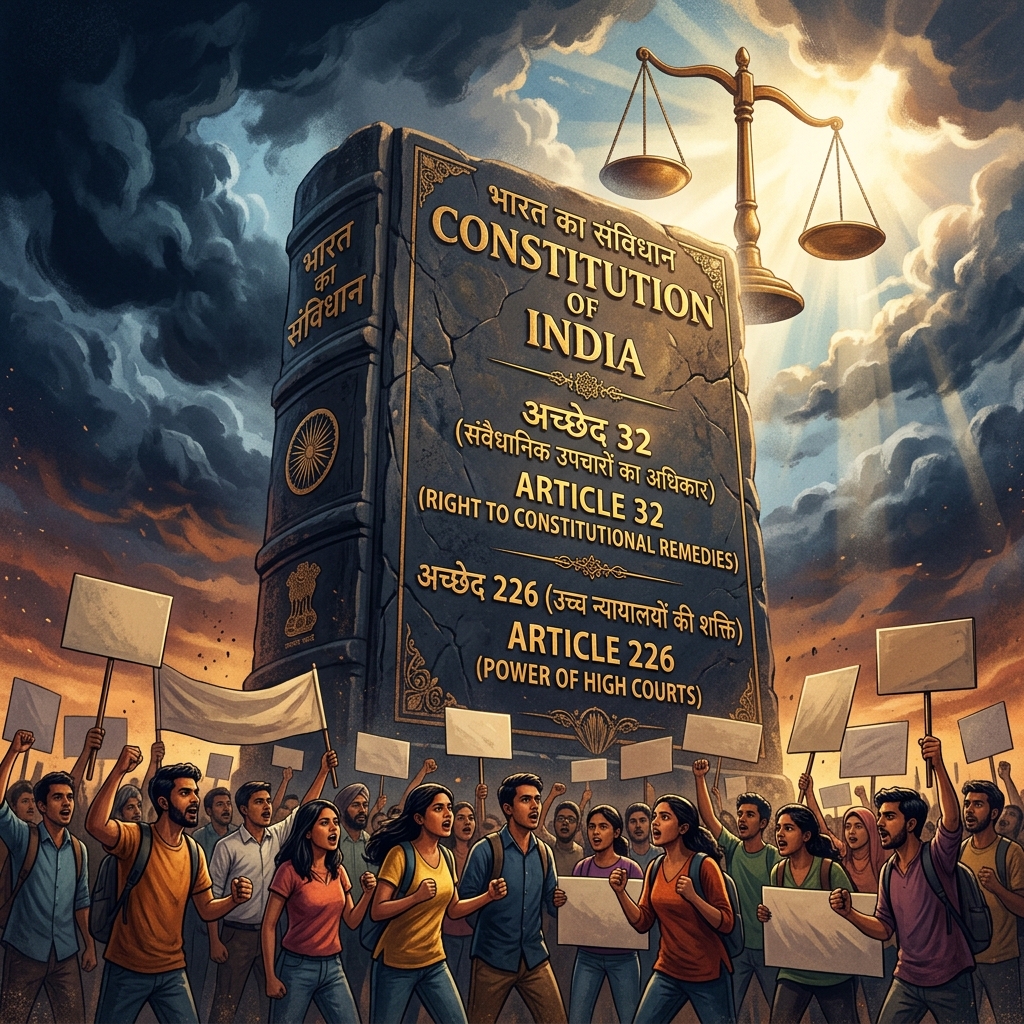
India's student movements have always been the canary in the democracy's coal mine. From the JP Movement of 1974 to the anti-CAA protests of 2019, and now the sweeping campus agitations of 2025–2026, young Indians have taken to the streets to demand accountability, fairness, and the fundamental rights guaranteed to them by the Constitution. But when batons replace dialogue and FIRs replace negotiation, the judiciary — armed with Article 32 and Article 226 — remains the last constitutional bulwark against authoritarian overreach.
I. The Current Crisis: Students Under Siege
As of mid-2026, India is witnessing an unprecedented wave of student protests across multiple states — from university fee hikes and examination irregularities (the NEET and NET controversies) to campus safety, hiring freezes, and the erosion of institutional autonomy. The state response has been deeply troubling:
- Mass detentions of peacefully protesting students under Sections 189–191 (unlawful assembly and rioting) of the Bharatiya Nyaya Sanhita (BNS), 2023 (formerly Sections 141–149 IPC)
- Internet shutdowns in campus areas, cutting students off from legal aid and media documentation
- Suspension and rustication as a tool of institutional retaliation, without following principles of natural justice
- Invocation of Section 144 CrPC (now BNSS Section 163) to pre-emptively ban all assemblies near universities
- Surveillance and doxxing of student leaders through digital monitoring
"Democracy is not merely a form of Government. It is primarily a mode of associated
living, of conjoint communicated experience."
— Dr. B.R. Ambedkar, Constituent Assembly Debates, 1949
II. Article 32: The "Heart and Soul" of the Constitution
Article 32 of the Constitution of India is no ordinary provision — Dr. Ambedkar himself called it "the very soul of the Constitution and the very heart of it." It guarantees every citizen the right to move the Supreme Court directly for the enforcement of fundamental rights under Part III.
Key Features of Article 32
| Clause | Provision | Student Relevance |
|---|---|---|
| 32(1) | Right to move the Supreme Court | Students can directly approach SC when fundamental rights are violated by state action |
| 32(2) | SC empowered to issue writs: Habeas Corpus, Mandamus, Prohibition, Certiorari, Quo Warranto | Habeas Corpus is critical when students are illegally detained; Mandamus compels universities to follow due process |
| 32(3) | Parliament may empower other courts to exercise similar jurisdiction | Expands access so students need not always travel to Delhi for relief |
| 32(4) | This right cannot be suspended except as provided in the Constitution | Even during emergencies (post-44th Amendment), Article 20 and 21 rights remain enforceable — a lesson from the dark chapter of 1975 |
Landmark Judgments Protecting Student Rights under Article 32
- Romesh Thappar v. State of Madras (1950) — The Supreme Court held that freedom of speech under Article 19(1)(a) includes the right to propagate ideas. Banning student publications or shutting down campus internet directly violates this principle.
- Maneka Gandhi v. Union of India (1978) — Expanded Article 21 to include the right to live with dignity. Any state action — lathi charges, tear gas, arbitrary rustication — that degrades a student's dignity is constitutionally impermissible.
- Anuradha Bhasin v. Union of India (2020) — The Court ruled that internet access is a fundamental right under Articles 19 and 21. Campus internet shutdowns during protests are therefore subject to constitutional scrutiny.
III. Article 226: The High Courts' Broader Shield
While Article 32 is limited to enforcement of fundamental rights before the Supreme Court, Article 226 empowers every High Court to issue writs for the enforcement of fundamental rights and for any other purpose. This broader scope makes Article 226 the primary and most accessible judicial remedy for students.
Why Article 226 is More Powerful for Students
| Feature | Article 32 | Article 226 |
|---|---|---|
| Court | Supreme Court only | Any High Court with territorial jurisdiction |
| Scope | Fundamental rights only (Part III) | Fundamental rights + any other purpose (legal rights, contractual rights, etc.) |
| Accessibility | Requires travel to Delhi; high costs | Available in every state; more accessible to students |
| Against whom | State/State instrumentalities | State + private bodies performing public functions (private universities, exam bodies) |
| Interim relief | Available but harder to obtain | Stay orders and interim injunctions routinely granted — critical for preventing irreversible harm like expulsions |
Practical Applications for Student Protesters
Writ of Habeas Corpus
When students are detained without arrest memos, denied access to lawyers, or held beyond statutory time limits. In the 2024 JNU detentions, habeas corpus petitions secured release within 24 hours. Ref: ADM Jabalpur v. Shivkant Shukla (1976) — the dissent of Justice H.R. Khanna is now the accepted law after the 44th Amendment.
Writ of Mandamus
To compel universities to follow their own statutes before suspending or expelling students. Universities receiving government funding are "State" under Article 12 and are bound by Part III obligations. Ref: Ajay Hasia v. Khalid Mujib (1981).
Writ of Certiorari / Prohibition
To quash arbitrary disciplinary orders passed without hearing the student (violation of audi alteram partem) or to restrain exam bodies from implementing discriminatory re-examination policies.
IV. Fundamental Rights Under Attack: What Students Are Losing
Article 19(1)(a) — Freedom of Speech and Expression
The right to protest is a constitutionally protected form of expression. The Supreme Court in Shreya Singhal v. Union of India (2015) struck down Section 66A of the IT Act precisely because it chilled free speech. Yet today, students face:
- Social media surveillance and FIRs for posting criticism online
- Seizure of mobile phones and laptops during protests
- Pressure on families and threats to withdraw scholarships
Article 19(1)(b) — Right to Assemble Peacefully
The right to peaceful assembly is not absolute — the state may impose "reasonable restrictions" under Article 19(2) and 19(3). However, blanket bans under Section 144 CrPC / Section 163 BNSS that prohibit all assembly near a university for weeks or months are disproportionate and have been struck down repeatedly.
Mazdoor Kisan Shakti Sangathan v. Union of India (2018): "Citizens have a fundamental right to peaceful assembly without arms. The right to protest is a part of the fundamental right under Article 19(1)(a) and (b). It can only be restricted by a law that is reasonable and falls within the ambit of Article 19(2) and (3)."
Article 21 — Right to Life and Personal Liberty
Article 21 has been interpreted expansively to include:
- Right to education — Arbitrary cancellation of examination results or denying degree certificates as punishment violates this right
- Right to livelihood — Rustication that destroys career prospects
- Right to dignity — Police brutality on campus, strip searches, and humiliation during detention
- Right to privacy (K.S. Puttaswamy v. Union of India, 2017) — Surveillance of student activists
- Right to access the internet (Anuradha Bhasin, 2020) — Campus-wide internet shutdowns
Article 14 — Right to Equality
When universities selectively punish students who participated in protests while ignoring others, or when examination authorities apply different standards to different candidates, Article 14's guarantee of equal protection is violated. The doctrine of intelligible differentia requires that any classification must bear a rational nexus with the object of the law.
V. The Dying Democracy: Institutional Erosion and the Chilling Effect
The phrase "dying democracy" is no longer hyperbole when international indices consistently downgrade India's democratic standing. The V-Dem Institute has classified India as an "electoral autocracy" since 2021. Freedom House categorises India as "partly free." The pattern is unmistakable:
VI. A Legal Toolkit for Protesting Students
Students facing state or institutional repression have concrete legal remedies available. Below is a practical framework:
🔴 Immediate: During or After Detention
- File Habeas Corpus petition under Article 226 in the nearest High Court
- Demand arrest memo (Section 41B CrPC / Section 36 BNSS) — failure to provide is itself grounds for release
- Exercise right to legal counsel (Article 22(1)) — the police cannot deny this
- Contact the NHRC or SHRC for urgent human rights intervention
🟡 Short-Term: Against University Action
- File Writ of Mandamus / Certiorari under Article 226 challenging suspensions passed without a hearing
- Seek interim stay on rustication orders to prevent irreparable harm to academic career
- Invoke principles of natural justice — audi alteram partem (right to be heard) and nemo judex in causa sua (no one should be judge in their own cause)
🟢 Long-Term: Systemic Challenges
- File PIL under Article 32 challenging the constitutionality of blanket Section 144 / Section 163 orders near educational institutions
- Challenge the IT Rules 2021 provisions used to remove student protest documentation from social media
- Advocate for Campus Protection legislation modelled on protections in mature democracies (cf. the US First Amendment campus speech protections)
VII. The Judiciary: Last Guardian or Silent Spectator?
The judiciary's track record on student protests has been mixed. On one hand, High Courts have shown remarkable courage:
- The Allahabad High Court struck down blanket Section 144 orders during anti-CAA protests as unconstitutional
- The Delhi High Court in multiple instances ordered release of detained students, holding that "the right to protest is non-negotiable in a democracy"
- The Madras High Court restrained universities from retaliatory action against students exercising their democratic rights
On the other hand, the Supreme Court's reluctance to hear urgent matters during politically sensitive periods, the increasing use of "sealed cover" evidence, and the long delays in hearing fundamental rights cases all contribute to a sense that the judiciary is being structurally weakened.
S.R. Bommai v. Union of India (1994): "Democracy is the basic feature of our constitutional set up. No Government can become combative to democracy... The courts are the guardians of the Constitution. They must remain vigilant."
VIII. Conclusion: The Constitution is the Students' Shield
The Indian Constitution was forged in the fires of a freedom struggle. Its framers — many of them former student activists — deliberately embedded robust mechanisms to protect dissent against future governments that might forget the democratic promise. Articles 32 and 226 are not abstract provisions; they are living weapons of constitutional self-defence.
When students are beaten on campuses, when internet shutdowns silence their voices, when universities punish them for speaking truth to power — the writs of habeas corpus, mandamus, certiorari, prohibition, and quo warranto stand ready. But these tools only work when:
- Students know their rights and exercise them proactively
- Lawyers take up these cases — often pro bono — as a matter of professional duty
- The judiciary acts with urgency rather than relegating fundamental rights to "the next date of hearing"
- Civil society holds all institutions accountable — not just the executive, but the legislature and the judiciary as well
"The price of liberty is eternal vigilance."
The right to protest is not a privilege granted by the state — it is a fundamental right
guaranteed by the Constitution. No lathi, no FIR, no rustication order can extinguish it.
When democracy trembles, it is the students who have historically held it upright.
Need Legal Assistance with Student Rights or Protest-Related Cases?
Our practice provides specialised representation for students facing illegal detention, arbitrary disciplinary action, or prosecution for exercising their constitutional right to peaceful protest. We file writ petitions under Articles 226 and 32, seek bail and interim relief, and pursue systematic challenges to unconstitutional state action. Contact us for a consultation →