
From Corporate Liability to Personal Rights: The Section 43A to DPDP Journey
Published on January 3, 2026 • 15 min read
Imagine this: It's 2011, and you receive a letter from your bank. They regret to inform you that your credit card details, PAN number, and address were "accidentally exposed" in a data breach affecting 3.2 million customers. The bank offers you one year of free credit monitoring and an apology. No compensation. No accountability. Just "we're sorry."
This was the reality of data protection in India before the strengthening of legal frameworks. While Section 43A of the IT Act, 2000 technically existed, its enforcement was minimal, its penalties were unclear, and the concept of "personal data" itself was loosely defined. The journey from that vague liability clause to today's comprehensive Digital Personal Data Protection Act is a story of technological awakening, judicial intervention, and legislative evolution.
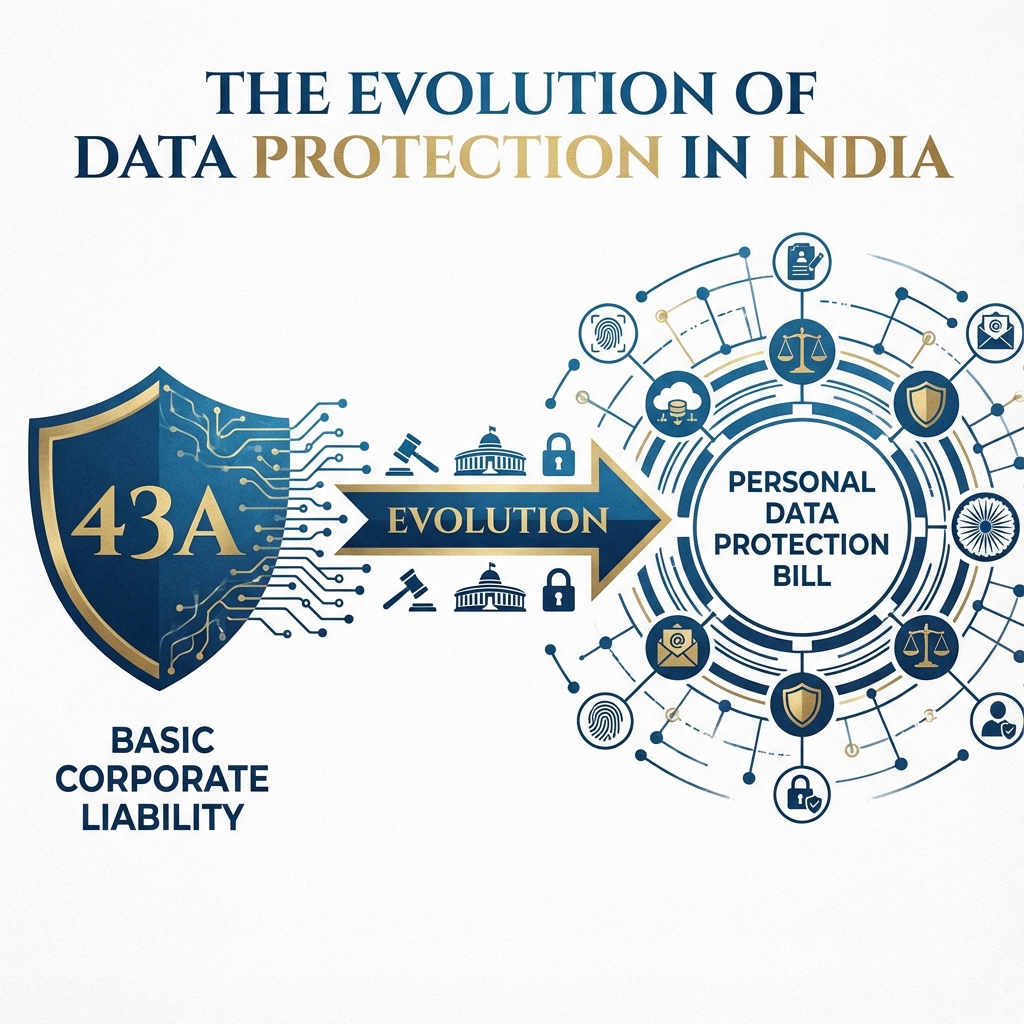
The Genesis: Section 43A and the First Step Toward Corporate Accountability
Section 43A was introduced through the 2008 Amendment to the IT Act, making India one of the early adopters of data protection legislation among developing nations. Its purpose was straightforward yet revolutionary for its time: make companies responsible for the personal data they collect.
What Section 43A Says
The section imposes liability on any "body corporate" (company, firm, or organization) that:
- Possesses, deals with, or handles sensitive personal data or information in a computer resource.
- Fails to implement and maintain reasonable security practices and procedures.
- Causes wrongful loss or wrongful gain to any person due to negligence in protecting that data.
If all three conditions are met, the affected individual can claim compensation from the company. Sounds simple, right? But there were critical gaps.
The Limitations of 43A
While progressive for 2008, Section 43A suffered from:
- Vague "Reasonable Security": What constitutes "reasonable" security? The IT Rules 2011 defined it as ISO 27001 compliance, but this was expensive and impractical for smaller firms. It became a checkbox exercise.
- No Consent Framework: 43A didn't mandate user consent for data collection. Companies could gather data freely as long as they "protected" it.
- Limited to "Sensitive" Data: Only categories like passwords, financial data, health records, and sexual orientation were protected. Everyday data like browsing history or location wasn't covered.
- Civil Remedy Only: 43A was a compensation mechanism, not a criminal deterrent. Companies calculated data breach fines as a "cost of doing business."
Between 2011 and 2017, despite dozens of high-profile breaches affecting Indian users (Aadhaar leaks, Zomato breach, etc.), not a single successful lawsuit was filed under Section 43A. Privacy advocates called it a "paper tiger."
The Turning Point: Right to Privacy as a Fundamental Right (2017)
Everything changed on August 24, 2017. In a historic nine-judge bench decision, the Supreme Court of India declared the Right to Privacy as intrinsic to life and personal liberty under Article 21 of the Constitution. Justice D.Y. Chandrachud's judgment was emphatic: "Informational privacy is a facet of the right to privacy. The dangers to privacy in an age of information can originate not only from the state but from non-state actors as well."
This was a direct indictment of the status quo. The court recognized that in the digital age, your data is an extension of your personhood. Its misuse is not just economic harm—it's a violation of dignity. Section 43A, with its focus on corporate compensation rather than individual rights, was inadequate for the constitutional vision the Court had articulated.
The Legislative Response: From Srikrishna Committee to DPDP Act
Recognizing the gap, the government constituted the Justice B.N. Srikrishna Committee in 2017 to draft a comprehensive data protection law. After extensive consultation, the Committee submitted the Personal Data Protection Bill, 2018, heavily inspired by the EU's GDPR.
The Long Gestation (2018-2023)
- 2019: The Bill was referred to a Joint Parliamentary Committee (JPC), which proposed 81 amendments and expanded the scope to include non-personal data.
- 2021: The revised Bill became controversial due to broad government exemptions, with critics calling it a "surveillance charter."
- 2022: Acknowledging the Bill had become too unwieldy, the government withdrew it in August and promised a "fresh, contemporary framework."
- 2023: The Digital Personal Data Protection (DPDP) Act was passed on August 11, 2023—a concise, principle-based law distinctly different from both Section 43A and the withdrawn PDP Bill.
Section 43A vs. DPDP Act: A Paradigm Shift
Let me illustrate the transformation with a real-world scenario:
Under Section 43A (2008-2023): If the data was encrypted, the company likely met "reasonable security." No breach, no liability. Your consent wasn't required.
Under DPDP Act (2023 onward): The company must obtain your explicit, informed consent before using your data for advertising. Selling it without consent is a direct violation punishable by fines up to ₹250 crore, imposed by the Data Protection Board—money that goes to the government, not you, emphasizing systemic accountability over individual compensation.
Key Differences
| Aspect | Section 43A | DPDP Act |
|---|---|---|
| Philosophy | Corporate Liability | Individual Rights |
| Consent | Not required | Mandatory, explicit |
| Penalties | Compensation to victim | Fines to exchequer (up to ₹250 Cr) |
| Data Rights | None | Right to access, correction, erasure, grievance |
| Regulator | Courts (civil suit) | Data Protection Board |
What This Means for Businesses in 2026
If your organization is still operating under the "43A mindset"—thinking data protection is just about firewalls and encryption—you're exposed. The DPDP Act requires:
- Consent Mechanisms: Clear, granular consent forms. Pre-checked boxes are invalid.
- Data Minimization: Collect only what's necessary for the stated purpose.
- Transparency: Users must know what data you hold and how it's used.
- Accountability: For "Significant Data Fiduciaries" (big tech, banks), you must appoint a Data Protection Officer and conduct independent audits.
- Cross-Border Compliance: Restrictions on transferring Indian user data to certain jurisdictions.
The transition from 43A to DPDP isn't just a legal upgrade—it's a cultural shift from "data as asset" to "data as trust."
The Road Ahead: DPDP Rules and Enforcement
While the DPDP Act is law, the detailed rules (expected in 2025-2026) will determine practical compliance. Early indications suggest:
- Standardized consent templates and withdrawal mechanisms.
- Clear timelines for Data Principal requests (e.g., 30 days to respond to erasure requests).
- Sector-specific exemptions (health, finance) with enhanced obligations.
Unlike Section 43A, which existed in regulatory vacuum for over a decade, the DPDP Act will have teeth from day one. The Data Protection Board, modeled on SEBI and TRAI, will be an independent regulator with suo moto powers to investigate violations.
Conclusion: Privacy as Dignity
The journey from Section 43A to the DPDP Act mirrors India's own digital maturation. In 2008, we saw data protection as a corporate risk management issue. By 2023, we recognize it as a fundamental human right. Section 43A was a necessary first step, teaching us that companies must be accountable. But the DPDP Act goes further: it asserts that individuals have sovereignty over their personal information.
For legal professionals, businesses, and citizens, this evolution demands engagement. The age of passive data subjects is over. The age of informed Data Principals has begun.
Is your organization ready for the DPDP transition? We offer comprehensive compliance audits, gap analysis from 43A frameworks to DPDP requirements, and legal representation for data breach litigation. Schedule a Consultation.