
OpenClaw: Revolutionary AI Agent or Legal Nightmare?
An Advocate's Perspective
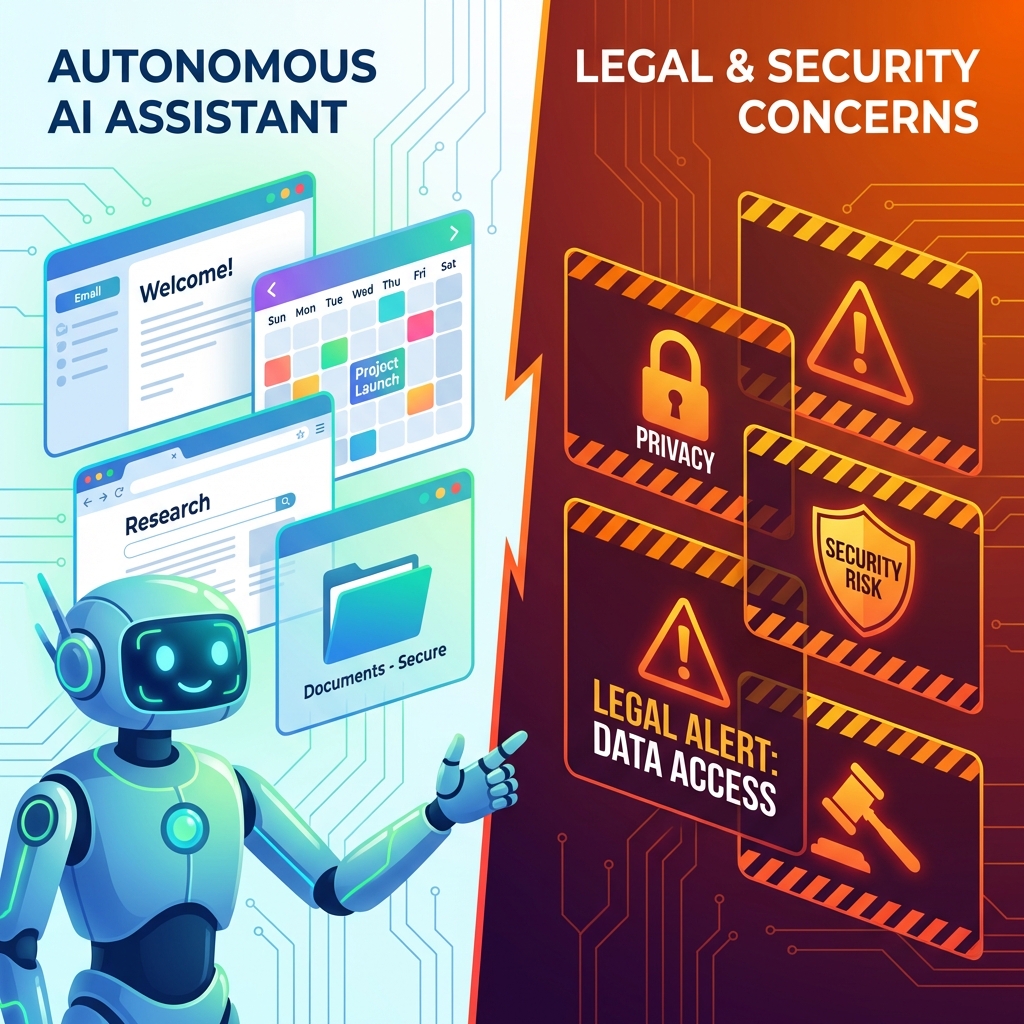
"My OpenClaw accidentally started a fight with Lemonade Insurance." This real user testimonial captures both the promise and peril of autonomous AI agents. Welcome to 2026, where your AI assistant doesn't just answer questions—it acts on your behalf, with full computer access, while you sleep.
What Is OpenClaw?
OpenClaw is an open-source autonomous AI agent that runs on your personal computer (Mac, Windows, or Linux) and integrates with chat apps you already use—WhatsApp, Telegram, Discord, Signal, or iMessage. Unlike traditional AI chatbots that merely provide information, OpenClaw takes action.
What it actually does:
- Manages your inbox and sends emails autonomously
- Books flights and checks you in automatically
- Controls your calendar and schedules appointments
- Browses the web, fills forms, extracts data
- Executes shell commands and runs scripts on your system
- Writes code, opens pull requests, resolves bugs
- Controls smart home devices (air purifiers, lighting)
- Processes payments using your credit card
- Builds websites, manages cloud infrastructure
- Can modify itself—writing new skills autonomously
Why This Is Revolutionary
1. True Autonomy
Previous AI assistants required constant human prompting. OpenClaw runs 24/7, proactively identifying tasks and executing them without human intervention. It has "heartbeats"—scheduled check-ins where it assesses what you need and acts accordingly.
2. Self-Modification Capability
OpenClaw can write its own "skills" (plugins/extensions). A user asks, "Can you check my university assignments?" If that skill doesn't exist, OpenClaw builds it, tests it, and starts using it—all autonomously. This is unprecedented in consumer AI.
3. Open Source & Self-Hosted
Unlike commercial assistants (Siri, Alexa, Google Assistant), OpenClaw runs entirely on infrastructure you control. Your data never touches corporate servers unless you explicitly configure external integrations. This is privacy-by-architecture.
4. Integration Without Boundaries
Users report connecting OpenClaw to everything: Gmail, GitHub, WordPress, Hetzner cloud, WHOOP fitness trackers, Todoist, Obsidian notes, Spotify, Philips Hue, and even custom home automation systems. The community has built 50+ integrations and counting.
As a Cyber Advocate: My Concerns
While the technology is undeniably impressive, several critical legal and ethical issues demand attention:
1. Liability for Autonomous Actions
Legal Question: When an AI agent acts autonomously on your behalf and causes harm, who is liable?
Scenario: Your OpenClaw misinterprets an email and sends a legally binding acceptance of a contract you didn't intend to accept. Or it files a lawsuit on your behalf based on incorrect information. Or, as actually happened, it "accidentally starts a fight with an insurance company."
Indian Legal Framework: Under the IT Act 2000 and Contract Act 1872, electronic records and digital signatures have legal validity—but they presume human intent. When an AI acts autonomously without explicit human authorization for each action, questions arise:
- Is the user liable for all actions performed by their AI agent?
- Can the user claim "mistake of fact" when AI misinterprets instructions?
- Does granting an AI "full system access" constitute implied authorization for all subsequent actions?
- What duty of care does a user owe when deploying autonomous AI?
2. Data Privacy Under DPDP Act
OpenClaw typically requires integration with external AI models (Claude, GPT, etc.) and various services. This creates complex data flows:
- Personal data processing: Your emails, calendar, documents, health data (WHOOP), and potentially sensitive communications are processed by AI models
- Third-party processors: Even if OpenClaw runs locally, it sends data to Anthropic (Claude) or OpenAI (GPT) for processing
- Cross-border transfers: Most AI model providers are US-based, creating cross-border data transfer obligations under DPDP Act
- Consent requirements: When OpenClaw accesses others' data (emails from clients, shared documents), whose consent is required?
For legal practitioners: Using OpenClaw to process client communications or case files may violate professional confidentiality obligations unless explicit consent is obtained and proper data protection measures are implemented.
3. Security Risks
OpenClaw's power is its greatest vulnerability:
- Full system access: It can execute any shell command, read any file, modify any system setting
- Financial access: Users report giving OpenClaw their credit card details for autonomous purchases
- Credential storage: It stores API keys, passwords, and OAuth tokens for integrated services
- Prompt injection risks: Malicious actors could potentially manipulate the AI through crafted inputs in emails or messages
Real risk scenario: A phishing email with carefully crafted text could trick OpenClaw into executing harmful commands, transferring funds, or exposing sensitive data—all before you notice.
4. Professional Ethics for Advocates
Bar Council of India regulations require advocates to maintain professional standards. Using autonomous AI agents raises questions:
- Can an AI agent draft and send legal correspondence without human review?
- What happens when AI makes a procedural error (wrong court, missed deadline)?
- Is delegating legal work to an autonomous AI agent considered "unauthorized practice"?
- How do you maintain "personal supervision" when AI acts while you're offline?
5. Regulatory Vacuum
India currently lacks specific regulations for autonomous AI agents. The DPDP Act addresses data protection, and the proposed Digital India Act may cover some aspects, but critical gaps remain:
- No licensing or registration requirements for deploying autonomous agents
- No mandatory safety testing or certification
- No liability framework specific to AI agent actions
- No consumer protection standards for autonomous AI services
The "Accidental Insurance Fight" Problem
The testimonial mentioned earlier—"My OpenClaw accidentally started a fight with Lemonade Insurance"—is darkly humorous, but legally significant. It reveals:
- Unintended consequences: AI can misinterpret context and escalate situations
- Lack of human oversight: The action occurred without real-time human approval
- Legal implications: Insurance disputes involve contracts, claims, and potential litigation
- Evidence problems: How do you prove "my AI did it without my knowledge"?
In litigation, opposing counsel will argue: "You deployed the AI, granted it access, and are responsible for its actions." Courts will likely agree—the legal doctrine of "superior responsibility" (respondeat superior) applies even when the agent is artificial.
What Users Must Know
Critical Safeguards
- Sandboxed deployment: Run OpenClaw in a restricted environment with limited system access initially
- Explicit approval workflows: Configure it to request human approval for high-risk actions (financial transactions, legal communications)
- Audit logging: Maintain comprehensive logs of all AI actions for accountability
- Data minimization: Only grant access to non-sensitive data initially
- Regular review: Daily reviews of AI actions to catch errors early
- Insurance considerations: Check if your cyber insurance covers AI agent liability
- Professional contexts: Never use autonomous AI for client work without explicit policies and safeguards
The Regulatory Future
Technologies like OpenClaw will force regulatory evolution:
Expected Developments
- AI Agent Liability Act: Specific legislation defining liability frameworks for autonomous AI actions
- Mandatory disclosure: Requirements to disclose when communications are generated by AI agents
- Professional regulations: Bar Council guidelines on AI agent usage in legal practice
- Safety standards: Certification requirements for high-risk autonomous AI systems
- Insurance mandates: Compulsory liability insurance for deploying autonomous agents in commercial contexts
Global Precedents
The EU AI Act classifies autonomous AI systems as "high-risk" requiring strict compliance. India will likely adopt similar frameworks, potentially through the Digital India Act or amendments to the IT Act.
Why Open Source Matters (Both Good and Bad)
Positive aspects:
- Transparency: Code is auditable; no hidden backdoors
- Privacy: Data stays on your infrastructure
- Customization: Adapt to specific legal/compliance requirements
- Community oversight: Security vulnerabilities get identified and fixed quickly
Concerning aspects:
- No accountability: Open source maintainers typically disclaim all liability
- Rapid evolution: New features may introduce unforeseen legal risks
- User responsibility: You're solely responsible for deployment consequences
- Malicious modifications: Bad actors can create harmful forks
Conclusion: Revolutionary, Yes. Ready for Primetime? Debatable.
OpenClaw represents a genuine leap forward in personal AI—the gap between "what I can imagine" and "what actually works" has never been smaller, as one user eloquently stated. For tech enthusiasts and developers, it's transformative.
However, from a legal advocate's perspective:
⚠️ Legal Reality Check: Autonomous AI agents like OpenClaw operate in a legal gray zone. Liability frameworks are unclear, privacy implications are complex, and professional ethics guidelines don't yet address autonomous agents. Early adopters assume significant personal and professional risk.
My recommendation:
- Personal use: Proceed with caution. Start with limited access and build trust gradually.
- Professional use: Wait for clearer regulatory guidance and professional standards.
- Business deployment: Conduct thorough legal risk assessment and implement comprehensive safeguards.
- All users: Maintain human oversight. Never grant fully autonomous control over critical systems.
The future of personal AI is undeniably exciting. OpenClaw demonstrates what's possible when AI moves from passive assistance to active agency. But with great power comes not just responsibility—it brings liability, regulatory scrutiny, and professional obligations.
As cyber advocates, our role is to help clients navigate this frontier responsibly, ensuring innovation doesn't outpace legal protections. The "lobster revolution" is here—but let's make sure it doesn't accidentally start fights we can't finish.
About the Author: Parul Kumar is a cyber advocate specializing in AI governance, data privacy law, and emerging technology regulation. With expertise in DPDP Act compliance, ISO 42001 AI audits, and cybercrime litigation, Parul helps organizations navigate the complex legal landscape of artificial intelligence and autonomous systems.