
Understanding Account Holds, Digital Banking Suspension, and Seizure Processes Under NCRP-CFCFRMS
⏱️ 3 min read
When a cybercrime victim reports a fraudulent transaction, what happens next? The Citizen Financial Cyber Fraud Reporting and Management System (CFCFRMS) has established critical processes for holding amounts, suspending digital banking services, and seizing accounts. Understanding these procedures is essential for banks, financial intermediaries, and account holders affected by cybercrime investigations.
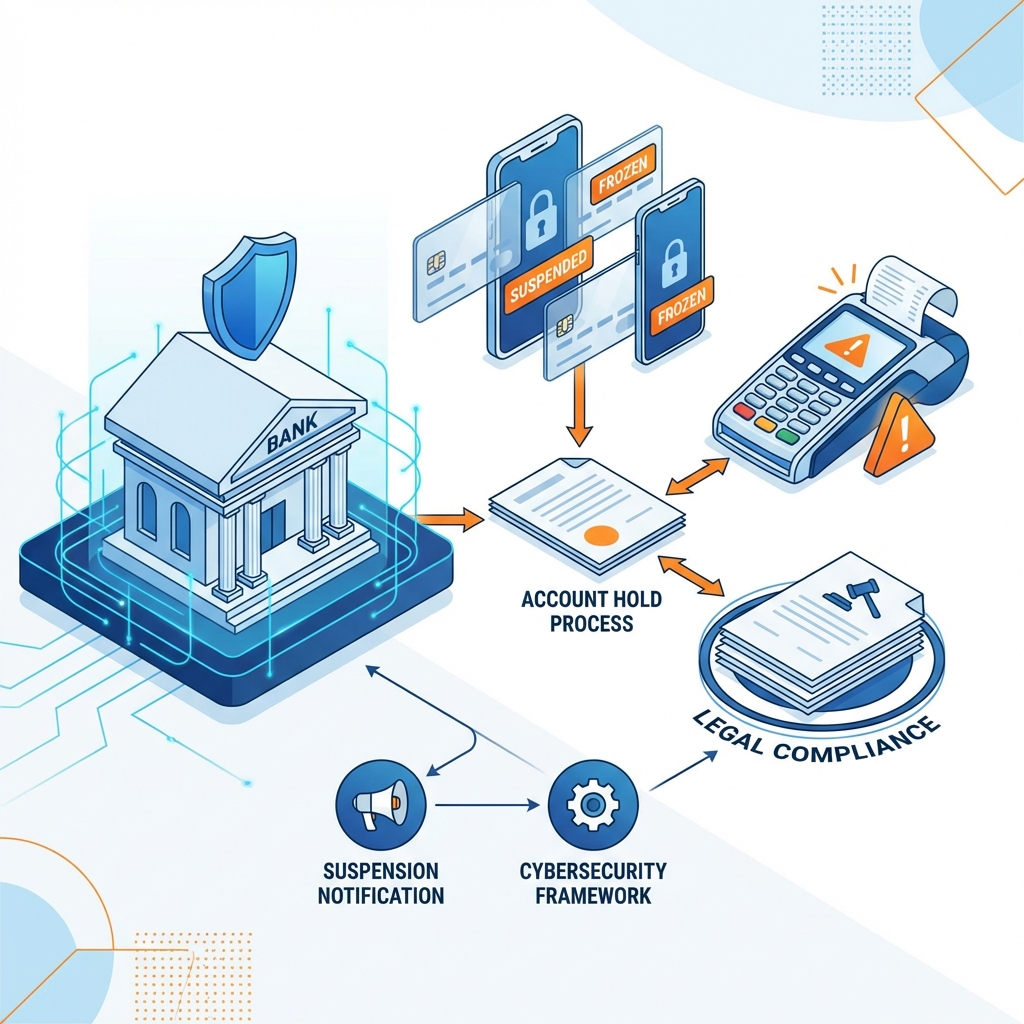
Legal Framework: Section 168, 94, and 106 BNSS
All actions to hold amounts, suspend services, or seize accounts under CFCFRMS are executed under the authority of Section 168 read with Section 94 of the Bharatiya Nagarik Suraksha Sanhita (BNSS) and Section 106 BNSS. These provisions provide Law Enforcement Agencies (LEAs) with the legal power to prevent defrauded money from being laundered and irretrievably lost while ensuring proper judicial oversight.
Measures Banks Must Take
Immediate Hold on Reported Amounts
When CFCFRMS notifies a bank about a transaction, and if the reported amount or any part thereof is available in the beneficiary account, the bank nodal officer must immediately put the amount on hold and update records as per the direction of LEAs. This is the first line of defense in preventing crime proceeds from disappearing.
Suspension of Digital Banking Services
If an account is reported multiple times on NCRP-CFCFRMS, banks shall suspend digital banking services including:
- Real Time Gross Settlement (RTGS)
- National Electronic Fund Transfer (NEFT)
- Immediate Payment Service (IMPS)
- Unified Payment Interface (UPI)
- Aadhaar Enabled Payment System (AePS)
- Automated Teller Machine (ATM) withdrawals
- Prepaid Payment Instruments (PPI) and card operations
Exception: Physical transactions at the branch remain operational. This balance ensures that legitimate account holders can access their funds through verified channels while preventing digital fraud.
Enhanced Due Diligence Requirements
Banks must adhere to Section 12AA of the Prevention of Money Laundering Act, 2002, and conduct Enhanced Due Diligence (EDD) on accounts reported to CFCFRMS. This involves analyzing accounts for patterns indicating their use as "money mule" accounts and understanding why they were opened and their involvement in cybercrimes.
Handling Insufficient Balance Scenarios
When adequate balance is not available in the suspect account, a hold shall be marked in the beneficiary account such that subsequent proceeds of crime can be put on hold. This prevents the account from being used further to transfer money defrauded from other victims. Importantly, in such cases, banks are not expected to return money to the victim whose funds have already been transferred elsewhere.
Special Treatment of Nodal, Pool, and Escrow Accounts
For nodal, escrow, or pool accounts, banks shall hold the disputed amount under Section 168 BNSS read with Section 94 BNSS. However, LEAs should normally refrain from ordering suspension or seizure of such accounts except in cases where other measures are deemed insufficient. Banks can reach out to LEAs for clarifications regarding these special account categories.
Measures for E-Commerce and Merchants
E-commerce companies and merchants face specific obligations when notified by CFCFRMS:
Order Cancellation and Amount Hold
If delivery of goods or services has not been made, the e-commerce company must:
- Cancel the order immediately
- Hold back the amount in the pool or nodal account
- Update details on CFCFRMS
Completed Transactions
If goods or services have already been delivered, the e-commerce company must update relevant details including order information, delivery address, and recipient identifiers on CFCFRMS to assist LEAs in tracking the crime proceeds.
Gift Cards, Coupons, and Wallets
For transactions involving purchase of coupons, gift cards, or wallet credits, companies must coordinate with issuers to cancel credit transactions, discredit the coupon or gift card if feasible, and hold the disputed amount.
Payment System Operators (PSOs) Obligations
PPI and CBDC Wallets
When reported amounts are loaded into Prepaid Payment Instrument (PPI) Wallets or Central Bank Digital Currency (CBDC) wallets, the wallet issuer must hold the disputed amount and update transaction details on CFCFRMS. If the amount has been transferred to another wallet, the receiving bank or PSO must put the amount on hold if available.
Wallet-to-Bank Account Transfers
If the amount is transferred from a wallet to a bank account that still holds the balance, the disputed amount shall be put on hold by the bank. If not available, beneficiary details must be updated on CFCFRMS to continue tracking the money trail.
Virtual Asset Service Providers (VASPs)
The rise of cryptocurrency exchanges as channels for laundering cybercrime proceeds has made VASPs critical participants in the CFCFRMS framework.
INR Credits
If reported amounts are held as INR credit in a customer's VASP account, the VASP must put the amount on hold and ensure the corresponding bank places a hold on the VASP's bank account.
Converted to Virtual Digital Assets (VDAs)
If the reported amount has been converted into VDAs (cryptocurrencies) and the assets are still available in the wallet, the VASP will notify LEAs. Upon lawful instructions, the VASP shall liquidate the VDAs into INR equivalent and ensure the converted amount is put on hold in the VASP's bank account.
Account Holder Rights and Information Sharing
When approached by an account holder affected by a hold or suspension, banks may inform them about the LEA's address and contact details without vitiating the criminal investigation. As clarified by the Financial Intelligence Unit in its circular dated June 2, 2025, such sharing of information when initiated by an LEA may not be considered a "tip-off."
Critical Protection: Under no circumstances shall the details of the complainant or victim be provided to the suspect account holder. This protects victims from potential retaliation or harassment.
Tracking Money That Has Exited
When money has moved out of financial channels through various modes, banks must provide related identifiers on CFCFRMS including:
- ATM ID and location details
- Applicable device IDs for mobile transactions
- Wallet details
- Point of Sale (POS) terminal information
- Cryptocurrency transaction details
- Cheque withdrawal information
Loan Accounts and Credit Card Repayments
A sophisticated challenge arises when defrauded amounts are used to repay loans or credit card dues. In such cases, the beneficiary bank or financial intermediary shall hold the disputed amount under Section 168 BNSS read with Section 94 BNSS after verifying the loan or credit card status. Additionally, other related Savings or Current accounts of the suspect account holder shall be notified on CFCFRMS for potential action.
The Coordinated Ecosystem
The effectiveness of the CFCFRMS framework depends on real-time coordination among all participating entities:
- Banks act as the primary gatekeepers
- Payment Aggregators and Gateways track through intermediary layers
- E-commerce platforms prevent goods delivery and identify recipients
- PSOs and Wallet Providers monitor digital payment channels
- VASPs address cryptocurrency conversion attempts
- LEAs provide legal authority and investigative follow-up
Balancing Crime Prevention and Rights Protection
These processes represent a delicate balance. On one hand, they provide powerful tools to prevent ₹7,647 Crore from reaching cybercriminals' hands (as of November 2025). On the other hand, they affect the fundamental rights of account holders, including those whose accounts may be compromised without their knowledge.
The framework recognizes this tension through:
- Preservation of physical branch banking access
- Information sharing with affected account holders
- Enhanced due diligence to identify money mule scenarios
- Special protections for nodal and escrow accounts
- Structured grievance redressal mechanisms
Conclusion: A Living Framework
The processes for holding amounts, suspending digital banking services, and seizing accounts under NCRP-CFCFRMS represent India's most comprehensive attempt to combat cyber-enabled financial crimes. As cybercriminals develop new techniques—from using cryptocurrency exchanges to exploiting gift card systems—the framework continues to evolve.
For financial institutions, compliance with these procedures is not optional—it's a legal requirement backed by BNSS provisions and the Prevention of Money Laundering Act. For account holders, understanding these processes is essential to knowing your rights and the pathways for grievance redressal if you believe your account has been wrongly flagged.
📄 Access the Complete Official Document
Download the full Standard Operating Procedure (SOP) for NCRP-CFCFRMS, Custody, Restoration of Money and Grievance Redressal issued by the Ministry of Home Affairs dated 02.01.2026.
📥 Download DBAG SOP.pdf (1.45 MB)Need Legal Assistance with Account Holds or Seizure Orders?
Our practice provides specialized representation for both cybercrime victims seeking restoration of funds and account holders affected by holds, suspensions, or seizure orders. We navigate the CFCFRMS framework and pursue remedies through appropriate legal channels including grievance redressal and judicial review.