
AI Chatbots for Legal Advocates: The Multibot Revolution in Law Practice
The legal profession is experiencing a seismic shift. AI chatbot tools—often called "multibot" platforms when using multiple AI assistants—are no longer experimental curiosities. They're becoming essential tools in modern legal practice, transforming how advocates research, draft, analyze, and strategize.
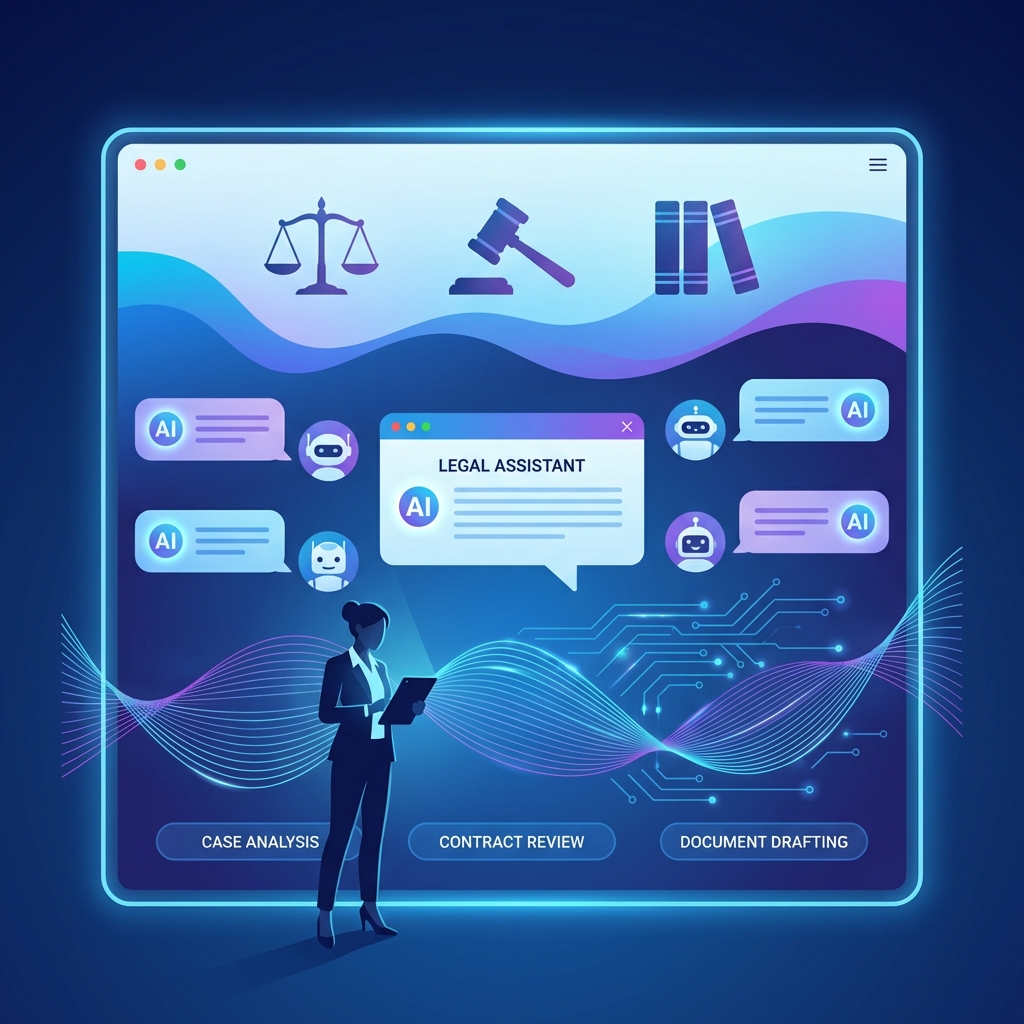
Understanding the Multibot Phenomenon
The term "multibot" refers to the practice of leveraging multiple AI chatbot platforms—such as ChatGPT, Claude, Gemini, Perplexity, and specialized legal AI tools—to maximize accuracy, reduce bias, and cross-verify legal research. Rather than relying on a single AI system, forward-thinking advocates use different AI models for different tasks, exploiting each platform's unique strengths.
Why Multiple AI Models?
- Different training data: Each AI model is trained on different datasets with varying cutoff dates, providing complementary perspectives.
- Specialized capabilities: GPT-4 excels at creative legal drafting, Claude at detailed analytical reasoning, Gemini at multimodal document analysis.
- Error mitigation: Cross-referencing outputs from multiple AIs reduces the risk of hallucinations and inaccuracies.
- Comprehensive coverage: One AI might miss a critical precedent that another identifies.
Practical Applications: How AI Chatbots Help Advocates
1. Legal Research & Precedent Discovery
AI chatbots can analyze vast databases of case law, identifying relevant precedents in seconds. For cyber advocates handling complex IT Act cases or DPDP Act compliance, this is transformative.
Real-world example: When researching Section 66E privacy violations, I can query multiple AI systems simultaneously. ChatGPT might provide comprehensive summaries of landmark judgments, while Claude offers detailed legal reasoning analysis, and Perplexity searches live databases for the latest 2026 rulings.
2. Document Drafting & Review
From legal notices to privacy policies, AI assistants dramatically accelerate document creation while maintaining quality:
- Privacy policies: Generate DPDP Act-compliant privacy policies tailored to specific business models
- Contract review: Identify risky clauses, ambiguous language, and compliance gaps in lengthy agreements
- Legal notices: Draft comprehensive notices under IT Act, Consumer Protection Act, or Contract Law
- Pleadings: Create initial drafts of plaints, written statements, and applications
3. Case Strategy Development
AI excels at scenario analysis. By feeding case facts to multiple AI models, advocates can explore different legal strategies, anticipate opposing arguments, and identify weaknesses in their own position before stepping into court.
4. Client Communication & Education
Complex legal concepts become accessible when explained by AI in plain language. Advocates can use AI to create client-friendly explanations of DPDP Act obligations, cybercrime procedures, or ISO 27001/42001 audit requirements.
5. Compliance Audits & Gap Analysis
For cyber advocates specializing in data protection and AI governance, chatbots are invaluable for conducting preliminary compliance audits:
- Analyzing organizational policies against DPDP Act requirements
- Identifying gaps in ISO 42001 AIMS implementation
- Reviewing consent mechanisms and data processing records
- Generating audit checklists and remediation roadmaps
The Hype vs. Reality: Understanding AI Limitations
While the enthusiasm around AI legal tools is justified, advocates must maintain a critical perspective:
What AI Can Do
- Accelerate research by summarizing cases and statutes
- Generate first drafts of standard legal documents
- Identify patterns across large document sets
- Explain complex legal concepts in accessible language
- Provide 24/7 productivity support without fatigue
What AI Cannot (Yet) Do
- Replace judicial reasoning: AI lacks the nuanced understanding of equity, justice, and societal context that judges apply
- Guarantee accuracy: Hallucinations remain a serious risk—AI can confidently cite non-existent cases
- Understand client emotions: The empathy and emotional intelligence required for client counseling cannot be automated
- Navigate courtroom dynamics: Oral advocacy, cross-examination, and strategic courtroom decisions remain human domains
- Exercise professional judgment: Ethical dilemmas, conflicts of interest, and strategic choices require human wisdom
Ethical and Professional Concerns
1. Confidentiality Risks
Critical warning: Never input confidential client information into public AI chatbots. Commercial AI platforms use inputs to train future models, potentially exposing sensitive data. Solutions include:
- Using enterprise versions with data protection guarantees (e.g., ChatGPT Enterprise, Claude for Enterprise)
- Anonymizing all case facts before AI input
- Using hypothetical scenarios instead of actual client data
- Implementing on-premise AI solutions for sensitive work
2. Verification Obligations
The Bar Council of India and professional ethics require advocates to personally verify all legal research and advice. AI-generated content must be treated as a first draft requiring rigorous human review. The advocate remains professionally liable for all outputs, regardless of AI involvement.
3. Unauthorized Practice Concerns
AI tools democratize legal information, but also risk enabling unauthorized practice of law. Advocates must ensure that AI-assisted services still meet the definition of professional legal practice and don't commoditize legal advice inappropriately.
4. Bias and Fairness
AI models trained on historical legal data may perpetuate existing biases in the legal system. Advocates using AI must actively watch for discriminatory patterns in AI-generated recommendations, particularly in criminal defense, family law, and constitutional matters.
How AI Chatbots Specifically Help Cyber Advocates
For practitioners in technology law, AI tools offer specialized advantages:
IT Act & Cybercrime Analysis
- Rapid analysis of digital evidence and technical forensic reports
- Explaining complex technical concepts for court submissions
- Researching international cybercrime precedents and MLAT procedures
- Drafting technical-legal documents (e.g., Section 65B certificates, digital evidence affidavits)
DPDP Act Compliance
- Generating data processing impact assessments
- Drafting consent mechanisms and privacy notices
- Analyzing cross-border data transfer frameworks
- Creating compliance documentation for Data Protection Board filings
AI Governance & ISO Standards
- Understanding ISO 42001 AIMS requirements
- Analyzing AI risk management frameworks
- Researching global AI regulations (EU AI Act, US state laws, Singapore model framework)
- Drafting AI ethics policies and algorithmic transparency documentation
Best Practices for Using AI Chatbots in Legal Practice
- Always verify citations: Check every case reference against primary sources. AI hallucinations are common.
- Use multiple models: Cross-reference research across ChatGPT, Claude, and specialized legal AI platforms.
- Anonymize client data: Remove all identifying information before inputting case facts.
- Maintain human oversight: AI is an assistant, not a replacement for professional judgment.
- Document AI usage: Keep records of how AI assisted in case preparation for professional compliance.
- Stay updated: AI capabilities evolve rapidly—regularly reassess which tools suit which tasks.
- Develop effective prompts: Clear, specific, context-rich queries yield better results.
- Understand limitations: Know when AI assistance is inappropriate (e.g., sensitive negotiations, courtroom strategy).
The Future: Where This Is Heading
The integration of AI in legal practice is accelerating. Here's what we anticipate:
Specialized Legal AI Models
General-purpose chatbots will give way to jurisdiction-specific legal AI trained exclusively on Indian case law, statutes, and regulatory guidance. Imagine an AI that understands the nuances of Delhi High Court practice versus Bombay High Court precedents.
Regulatory Framework Development
The Bar Council of India will likely issue comprehensive guidelines on AI usage in legal practice, addressing confidentiality, verification standards, disclosure requirements, and professional liability.
Court Integration
Courts may begin accepting AI-assisted legal research, provided it meets verification standards. Some jurisdictions globally are already experimenting with AI-powered legal research platforms integrated into judicial systems.
Democratization of Legal Services
AI will make basic legal information more accessible to the public, while advocates evolve toward higher-value strategic advisory roles requiring irreplaceable human judgment and creativity.
Conclusion: Embracing the Tool, Not Replacing the Professional
AI chatbots—particularly when used in multibot configurations—represent the most significant technological shift in legal practice since computerized legal research databases. They offer unprecedented speed, scale, and analytical power.
However, AI is a tool, not a replacement. The practice of law remains fundamentally a human endeavor requiring judgment, empathy, ethical reasoning, and advocacy skills that no algorithm can replicate.
As cyber advocates and AI lawyers, our role is to master these tools while maintaining the professional standards and ethical obligations that define our profession. Those who successfully integrate AI into their practice—understanding both its power and its limitations—will be best positioned to serve clients effectively in the digital age.
About the Author: Parul Kumar is a cyber advocate specializing in technology law, data privacy, AI governance, and digital forensics. With expertise in DPDP Act compliance, ISO 42001 audits, and cybercrime litigation, Parul helps organizations navigate the complex intersection of law and emerging technology.